 Metadata Catalogue
Karakoram
Type of resources
Topics
Keywords
Contact for the resource
Provided by
Representation types
Update frequencies
status
-
The assessment of meltwater sourcing from the clean and debris-covered glaciers is scarce in High Mountain Asia (HMA). The melting rate varies with the debris cover thickness and glacier orientation. The present study quantifies glacier melting rate attributed to varying thickness of debris cover in the Karakoram. We observed the melting rates by installing ablation stakes on Hinarchi and Sachen glaciers over debris-free and debris-covered ice during a field expedition. The stakes were installed on clean ice and glacier surface with debris cover thickness ranges between 0.5 and 2 cm at selected experimental sites between 2700 and 3100 m a.s.l. during July 2021.
-
The assessment of meltwater sourcing from the clean and debris-covered glaciers is scarce in High Mountain Asia (HMA). The melting rate varies with the debris cover thickness and glacier orientation. The present study quantifies glacier melting rate attributed to varying thickness of debris cover in the Karakoram. We observed daily melting rates by installing ablation stakes over debris-free and debris-covered ice during a field expedition. The stakes were installed on glacier surface with debris cover thickness ranges between 0.5 and 40 cm at selected experimental sites during the ablation period (September to October 2018) and (July to August 2019). We selected three glaciers including Ghulkin, Hinarchi, and Hoper facing east, south, and north, respectively to assess the role of glacier orientation on melting rates. We observed that the debris-free ice melts faster than the debris-covered ice. Intriguingly, a thin debris layer of 0.5 cm does not enhance melting compared to the clean ice which is inconsistent with the earlier studies. The melting rate decreases as the thickness of debris cover increases at all the three selected glaciers. Furthermore, south-facing glacier featured the highest melting (on average ~ 25% more). However, the north and east-facing glaciers revealed almost same melting rates. For further information, please read the paper associated with this data: Muhammad, S., Tian, L., Ali, S., Latif, Y., Wazir, M.A., Goheer, M.A., Saifullah, M., Hussain, I. and Shiyin, L., 2020. Thin debris layers do not enhance melting of the Karakoram glaciers. Science of the Total Environment, 746, p.141119.
-
The dataset shows medicinal plant species found in the Khunjerab National Park and the use of medicinal plant by inhabitants of KNP.
-
The dataset shows mammal species found in the Khunjerab National Park and adjacent area of the park.
-
The dataset shows bird species found in the Khunjerab National Park and adjacent area of the park.
-
The dataset shows fish species found in the Khunjerab National Park and adjacent area of the park.
-
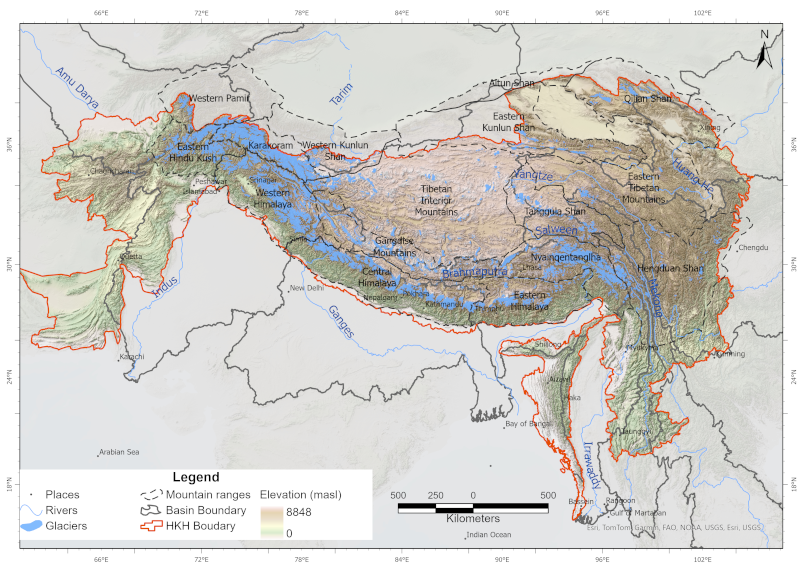
Glaciers are an indispensable component of the Hindu Kush Himalayan (HKH) region, acting as a vast “water tower” that stores large volumes of freshwater and sustains Asia’s ten major river systems, supporting ecosystems, communities, and livelihoods across the continent. This study presents a decadal glacier change dataset for the HKH region developed using a semi-automatic mapping approach to ensure high accuracy and enable reliable comparison of glacier changes over time. The dataset was generated using consistent data sources and methods, with Landsat imagery from 1990, 2000, 2010, and 2020, maintaining a narrow temporal window (±1 year from the base year) and a uniform spatial resolution. Glacier outlines were mapped at a scale of 1:50,000 with a minimum area threshold of 0.02 km². Glacier area and associated topographic parameters were derived using the Albers Equal Area projection and the global void-filled SRTM DEM v4. This dataset represents a first-of-its-kind, region-wide glacier inventory created using a consistent methodology and data source, providing a comprehensive assessment of glacier distribution and decadal change across the entire HKH region.