 Metadata Catalogue
1000000
Type of resources
Available actions
Topics
Keywords
Contact for the resource
Provided by
Years
Formats
Representation types
Update frequencies
status
Scale
-
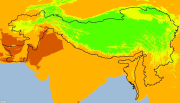
Digital grid dataset of monthly mean temperature (August) for the period of 1950-2000 of Hindu Kush Himalayan (HKH) Region. The dataset is derived from WorldClim (http://www.worldclim.org/), and major climate databases compiled by the Global Historical Climatology Network (GHCN), the FAO, the WMO, the International Center for Tropical Agriculture (CIAT), R-HYdronet. Monthly mean temperature data set consists of 12 raster files, one for each month, showing mean values derived from monthly temperature readings. The data layers were generated through interpolation of average monthly climate data from weather stations on a 30 arc-second resolution grid.
-
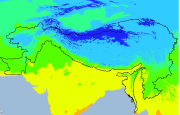
Digital grid dataset of minimum monthly temperature (February) for the period of 1950-2000 of Hindu Kush Himalayan (HKH) Region. The dataset is derived from WorldClim (http://www.worldclim.org/), and major climate databases compiled by the Global Historical Climatology Network (GHCN),the FAO, the WMO, the International Center for Tropical Agriculture (CIAT), R-HYdronet. Monthly Precipitation data set consists of 12 raster files, one for each month, showing minimum mean values derived from monthly temperature readings. The data layers were generated through interpolation of average monthly climate data from weather stations on a 30 arc-second resolution grid.
-
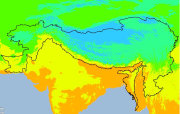
Digital grid dataset of minimum monthly temperature (October) for the period of 1950-2000 of Hindu Kush Himalayan (HKH) Region. The dataset is derived from WorldClim (http://www.worldclim.org/), and major climate databases compiled by the Global Historical Climatology Network (GHCN),the FAO, the WMO, the International Center for Tropical Agriculture (CIAT), R-HYdronet. Monthly Precipitation data set consists of 12 raster files, one for each month, showing minimum mean values derived from monthly temperature readings. The data layers were generated through interpolation of average monthly climate data from weather stations on a 30 arc-second resolution grid.
-
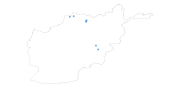
Digital point dataset of Water Resource Features (springs, well and Dams) of Afghanistan. This dataset is basic vector layer acquired from USGS.
-
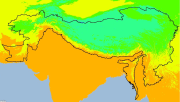
Digital grid dataset of monthly mean temperature (October) for the period of 1950-2000 of Hindu Kush Himalayan (HKH) Region. The dataset is derived from WorldClim (http://www.worldclim.org/), and major climate databases compiled by the Global Historical Climatology Network (GHCN), the FAO, the WMO, the International Center for Tropical Agriculture (CIAT), R-HYdronet. Monthly mean temperature data set consists of 12 raster files, one for each month, showing mean values derived from monthly temperature readings. The data layers were generated through interpolation of average monthly climate data from weather stations on a 30 arc-second resolution grid.
-
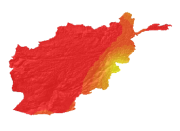
Digital grid dataset of Monthly Mean Precipitation of July of Afghanistan. This dataset is acquired from USGS.
-
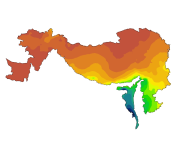
Digital grid data of Mean Precipitation of October for Hindu Kush Himalayan (HKH) Region. This dataset is acquired from USGS.
-
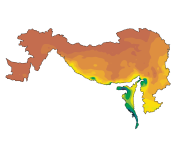
Digital grid data of Mean Precipitation of September for Hindu Kush Himalayan (HKH) Region. This dataset is acquired from USGS.
-
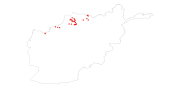
Digital point dataset of Location of Major Energy Resources of Afghanistan. This dataset is acquired from USGS.
-

Digital point dataset of Geographic names (Gazetteer) of Major places and sites of Hindu Kush Himalayan (HKH) Region. This dataset is Basic Vector layer derived from ESRI Map & Data 2001.